AI Leaders Are Easy to Find. Business Operators Are Not.
Artificial intelligence is everywhere. Every organization is talking about it, prioritizing it, and creating hiring plan includes it.
And yet, many companies are still struggling to generate real business value from AI.
The issue is not access to talent. It is alignment on what kind of leadership is actually needed.
The Shift from Technical Expertise to Business Impact
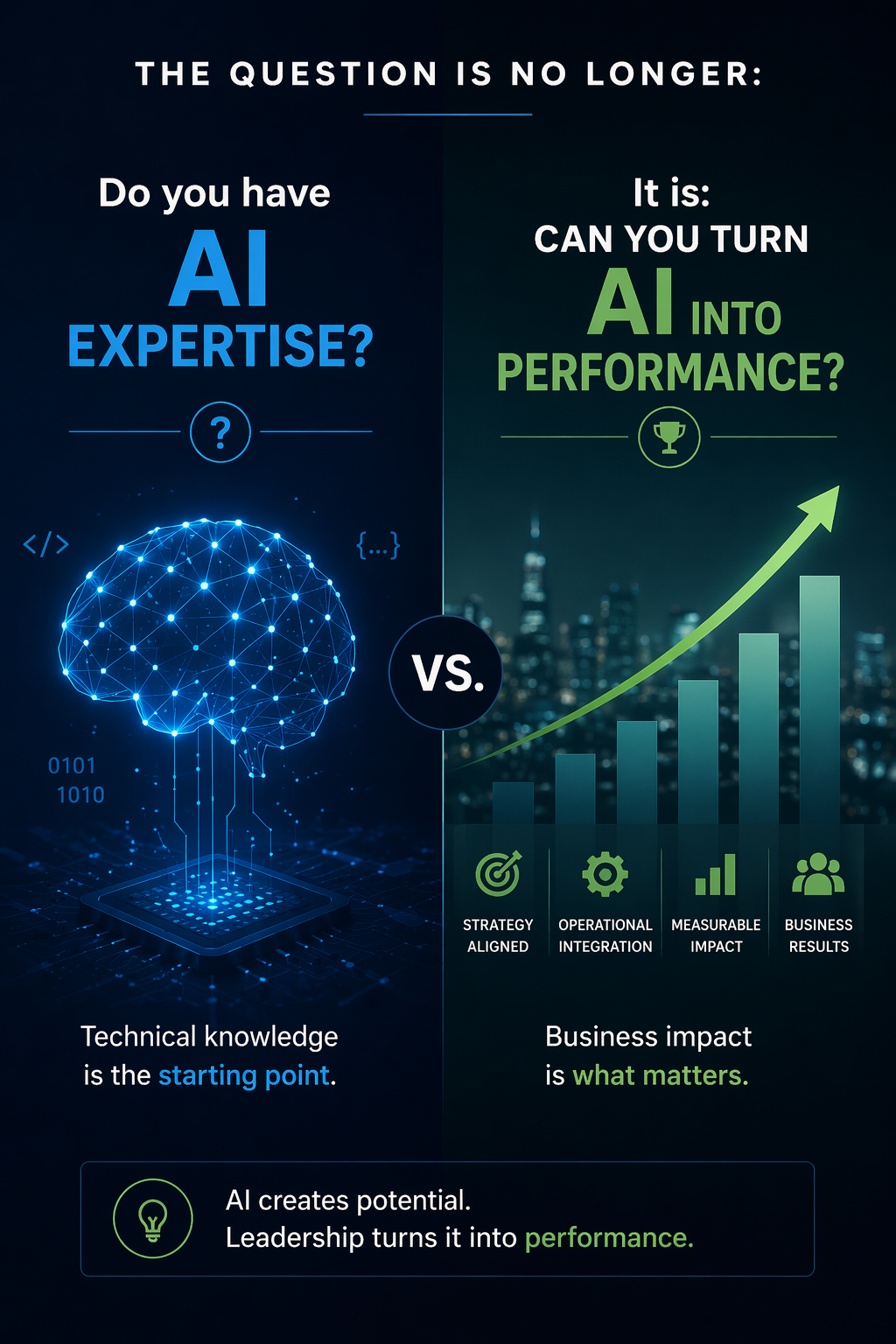
What I'm seeing across the market is a fundamental shift in how AI leadership should be defined. Early hiring cycles focused heavily on technical expertise (machine learning experience, model development, engineering depth). Those are still important, but they are no longer enough.
According to McKinsey & Company, organizations are increasingly focused on how AI drives measurable business outcomes, not just technical capability.
The expectation has changed. Companies are no longer hiring AI leaders to build. They are hiring them to deliver.
The Gap Between Capability and Execution
This is where most hiring processes break down. Organizations define roles around capability. But success is determined by execution.
There is a difference between:
Building an AI model
Deploying it at scale
Integrating it into business operations
Driving measurable ROI
The leaders who can do all four are rare. And they are not typically found through traditional hiring channels.
AI Leaders vs AI Operators
Not all AI leaders are built the same. There is a clear distinction emerging in the market. AI leaders who focus on technology tend to prioritize innovation and development. However, AI operators focus on outcomes.
They understand how to:
Align AI initiatives with business strategy
Build operating models that support adoption
Evaluate what is working and what is not
Make decisions based on impact, not theory
The Role of Data, Cybersecurity, and Decision Making
AI does not operate in isolation, it sits at the intersection of data, security, and business strategy.
According to Deloitte, organizations are placing increasing emphasis on leaders who can integrate AI into broader digital ecosystems while managing risk and governance.
At the executive level, this requires:
Strong data-driven decision making
Awareness of cybersecurity implications
Ability to operate within regulatory and compliance frameworks
These are not technical challenges alone. They are leadership challenges.
Why Many AI Hires Fall Short
One of the most common issues in AI hiring is misalignment at the outset.
Companies move quickly to hire AI talent without clearly defining:
What success looks like
How AI will be integrated into the business
What resources and support are required
How performance will be measured
Without that clarity, even strong hires struggle.
Research from Harvard Business Review continues to show that transformation initiatives often fail due to leadership misalignment and lack of clear execution frameworks.
AI is no different.
The Leaders Who Succeed
The most effective AI leaders share a consistent set of characteristics. They are not just technologists, they are operators.
They understand how to:
Translate technical capability into business value
Lead cross-functional teams
Drive adoption across the organization
Make decisions in fast-moving environments
Balance innovation with execution
They are comfortable operating in ambiguity, but they are focused on outcomes.
What This Means for Executive Hiring
AI has changed the expectations for leadership. But many hiring strategies have not caught up. Organizations are still evaluating candidates based on technical background rather than business impact.
They are prioritizing resumes over results. They are hiring for capability instead of execution. The result is predictable.
Strong talent that does not translate into performance.
If you are evaluating how AI fits into your organization or thinking through leadership alignment, I am always open to a conversation.