The Tribal CFO Hiring Guide: Leadership Beyond Finance
The Tribal CFO Hiring Guide: Leadership Beyond Finance
Hiring a CFO within a Tribal enterprise is fundamentally different than hiring a CFO in a traditional corporate environment.
The role extends well beyond accounting, reporting, and financial oversight.
Tribal CFOs often operate at the intersection of enterprise leadership, governance, community priorities, long-term stewardship, and economic development.
That complexity changes what successful leadership looks like.
And it changes how the hiring process should be approached.
Tribal CFO Leadership Is Different by Design
Many Tribal enterprises operate across highly diversified business structures.
Gaming
Healthcare
Hospitality
Energy
Government contracting
Agriculture
Real estate
In many cases, the CFO is not overseeing a single business. They help guide a multi-entity enterprise ecosystem with varying operational models, regulatory environments, and stakeholder expectations.
That requires more than technical financial expertise. It requires enterprise leadership.
Governance Complexity Matters
One of the most overlooked aspects of Tribal CFO hiring is governance navigation.
Unlike many private sector organizations, Tribal enterprises often operate within layered governance structures that may include:
Tribal councils
Enterprise boards
Community leadership stakeholders
Economic development entities
Sovereign governance considerations
The CFO must be capable of operating effectively across all of them.
This is not simply a reporting relationship. It is a leadership environment that requires diplomacy, communication, trust-building, and strategic alignment.
The strongest candidates understand that financial leadership and governance alignment go hand in hand.
Financial Stewardship Has a Broader Meaning
In traditional corporate environments, financial leadership is often measured primarily through profitability, efficiency, and shareholder performance.
Within Tribal enterprises, financial stewardship frequently carries a broader responsibility.
The CFO is not simply protecting financial performance. They are often helping protect long-term sustainability, economic diversification, community investment, and future generations of opportunity.
That perspective changes decision making. It also changes the type of leader who succeeds.
Technical Expertise Alone Is Not Enough
Many organizations still approach CFO hiring through traditional lens seeking a strong accounting background, audit experience, and technical reporting expertise
Those capabilities matter. But they are not enough on their own.
Modern Tribal enterprises increasingly require CFOs who can:
Operate strategically across diversified enterprises
Navigate organizational complexity
Support long-term growth initiatives
Lead cross-functional teams
Communicate effectively with multiple stakeholders
Balance operational execution with long-term vision
The strongest Tribal CFOs are not just financial operators. They are strategic business leaders.
Cultural Alignment Is Often the Difference
One of the most common reasons executive hires struggle within Tribal organizations is not lack of capability, it is lack of alignment.
Leadership within Tribal Enterprises requires humility, listening, adaptability, and respect for sovereignty, governance, and community priorities.
The leaders who succeed understand that trust is earned over time.
They recognize the importance of relationship-building and long-term alignment rather than transactional leadership.
This is especially important in executive finance roles where transparency, communication, and credibility are critical.
The Difference Between a Traditional CFO and a Tribal CFO
A traditional CFO model often prioritizes quarterly performance and financial optimization.
A Tribal CFO role often requires balancing financial performance with long-term enterprise sustainability and community impact.
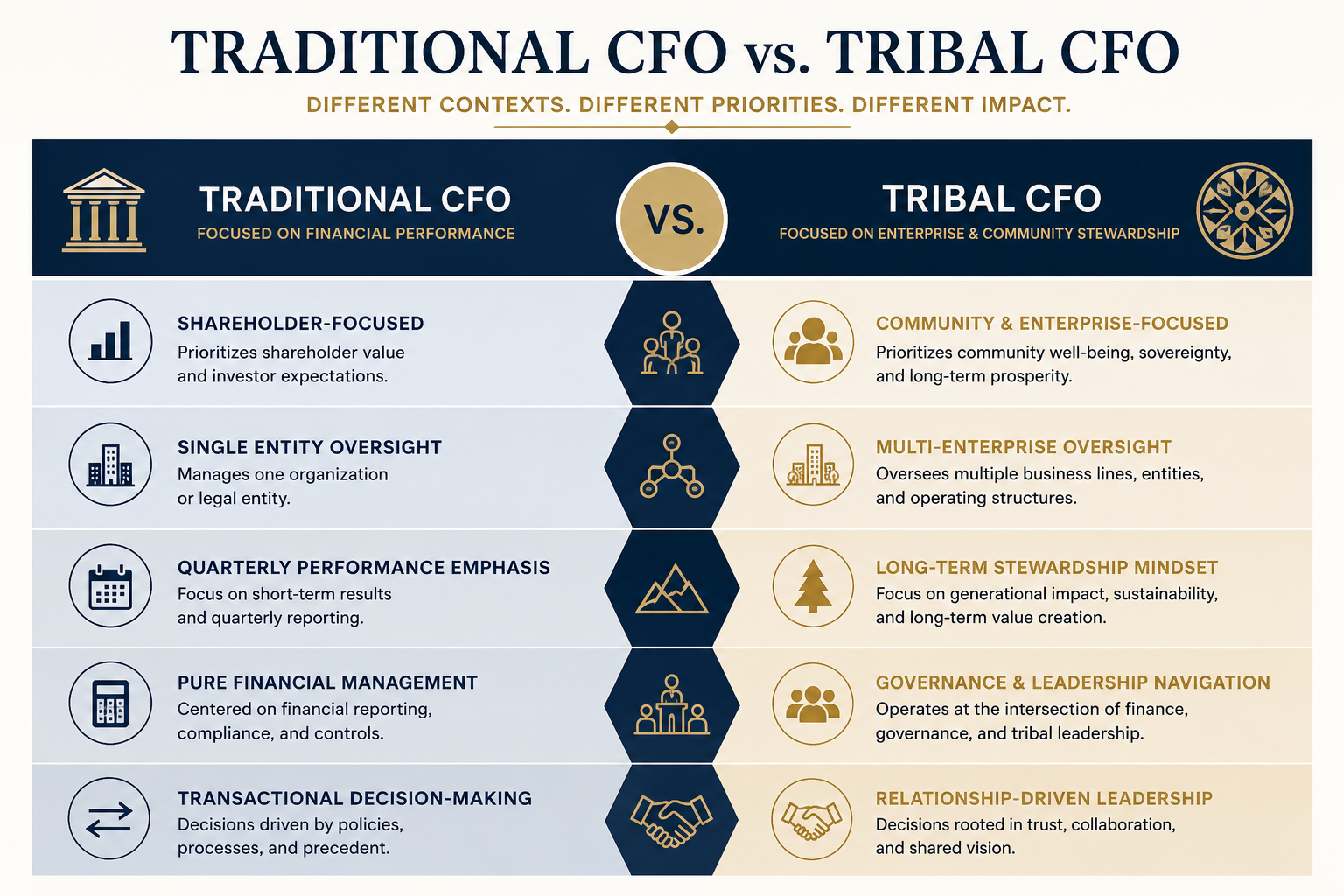
This is not a better-or-worse comparison. It is a fundamentally different leadership environment.
Common Tribal CFO Hiring Mistakes
What we continue to see across the market are organizations underestimating the complexity of the role.
Common hiring mistakes include:
Prioritizing technical credentials over leadership adaptability
Underestimating governance dynamics
Rushing the process
Lack of stakeholder alignment early in the search
Hiring based on resume pedigree alone
Failing to assess cultural alignment deeply enough
The cost of a misaligned executive hire at the CFO level can be significant. Especially in environments where leadership continuity and trust matter deeply.
Why the Hiring Process Itself Matters
Strong Tribal executive hiring processes are rarely transactional, they are intentional.
The most successful searches typically involve:
Early stakeholder alignment
Clear communication structures
Thoughtful candidate evaluation
Long-term fit assessment
Relationship-driven engagement
Longer timelines are not necessarily inefficiency. In many cases, they reflect the level of care required to make the right long-term leadership decision.
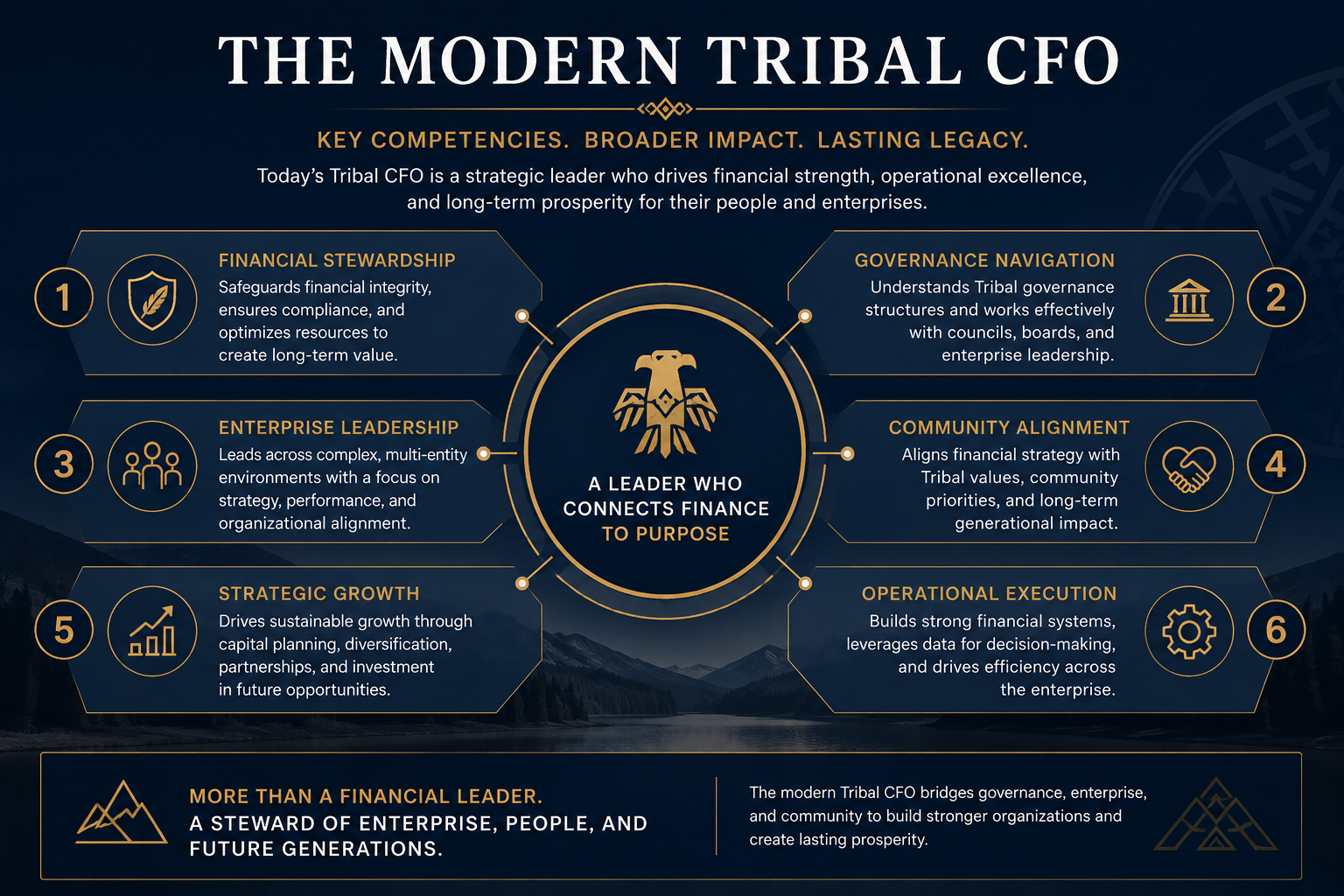
Key Competencies of the Modern Tribal CFO
The Takeaway
The strongest Tribal CFOs are not just financial leaders. They are enterprise leaders capable of balancing governance, operational complexity, long-term strategy, and community alignment.
That is what makes Tribal CFO hiring different.
And it is why the hiring process itself requires a deeper level of intentionality.
If your organization is evaluating finance leadership or planning for long-term enterprise growth, Torres Search Partners is always open to a conversation.